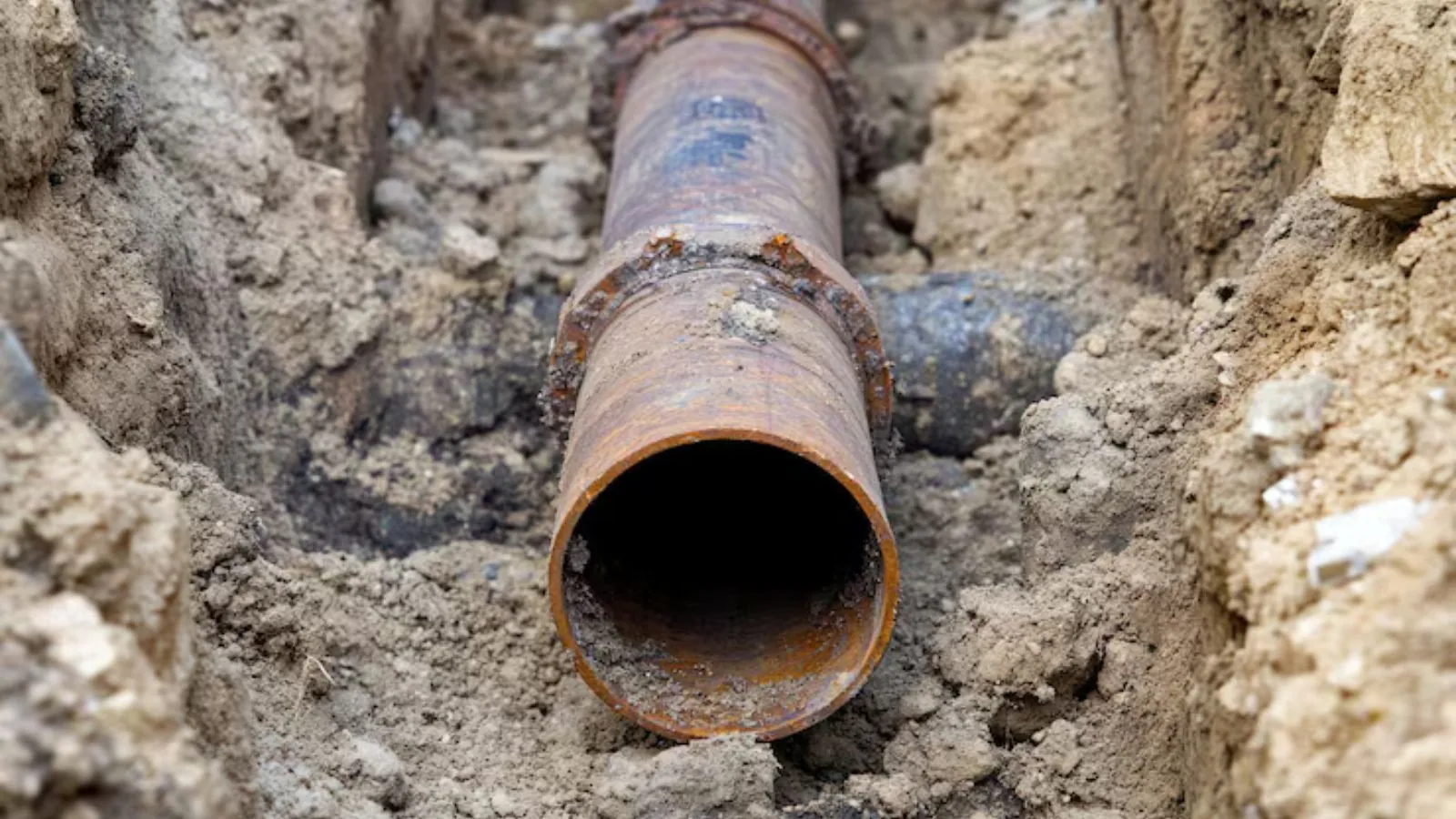
Galvanized steel pipe was widely used for residential water supply lines before copper and later PEX became the norm. Older Bellevue homes can still have it somewhere in the walls, under the floor or on the customer side of the meter, and the only way to know for sure is to look at the pipe itself.
How Galvanized Pipe Actually Fails
Galvanized pipe doesn't fail all at once. It fails gradually, from the inside, as the zinc coating that gives the pipe its name wears away and the steel underneath starts to corrode and rust. That corrosion narrows the interior of the pipe over years and sometimes decades, which shows up first as a slow decline in water pressure rather than a dramatic leak.
Eventually, a corroded section can fail outright, usually at a threaded joint where the metal is thinnest and under the most stress. That's when a slow, gradual problem turns into an emergency call. The timeline varies a lot by water chemistry and how the original installation was done, so age alone is not a reliable guide.
What Bellevue Utilities Says About Service Lines
Bellevue Utilities has a service line inventory that explains what the city knows about pipe materials. It says the utility has never used lead in service lines from the water main to the water meter. It also says homes built before 1968 could have lead pipes from the water meter to the house.
The city adds that construction may cause more lead to be released from a lead or galvanized service line if one is present. Most customer side materials are listed as unknown in the inventory, and the city provides an online service line locator so owners can look up their address.
That is why a physical check matters. A plumber can identify the material where the line enters the house, and a camera can show the condition inside accessible runs.
Source: City of Bellevue Utilities service line inventory page.
Signs Your Home Might Still Have It
- Water pressure that's noticeably lower at one fixture than another on the same floor.
- Water pressure that's gradually declined over the years rather than dropping suddenly.
- Rusty or discolored water when a faucet is first turned on after sitting unused, especially hot water.
- An older home with no documented repipe.
What This Means If You're Buying Or Already Living In One Of These Homes
If you're buying a home in one of Bellevue's older neighborhoods, it's worth asking directly whether the supply lines have been replaced, since that's not always obvious from a standard inspection unless someone specifically checks pipe material where it's visible. If you already live in a home like this, a gradual pressure decline over the years is worth a real inspection rather than an assumption that it's just how the house has always been.
Not every galvanized system needs immediate, whole-home replacement. Some homes have sections that are still sound and sections that are genuinely failing, and a proper inspection tells you which is which rather than defaulting to the most expensive fix. Where a repipe is warranted, PEX and copper are both solid modern options, and the right choice usually comes down to the home's layout and your own preference more than one being objectively better.
Partial Repipe Versus Whole-Home: How That Decision Actually Gets Made
Not every galvanized system needs to come out all at once. When we inspect a home with galvanized supply lines, we're checking the actual condition section by section, not just assuming uniform deterioration throughout. Some sections show real, active corrosion and reduced flow. Others, particularly shorter runs that see less use, sometimes remain in reasonably sound condition even in an otherwise aging system.
That inspection is what actually drives whether we recommend a full repipe or a more targeted, partial approach. A homeowner facing a real budget constraint sometimes reasonably chooses to address the worst sections first and monitor the rest, understanding that a fuller repipe may become necessary later. We'll walk through that trade-off honestly rather than defaulting to the most expensive recommendation regardless of what the inspection actually shows.
What We Actually Look For During An Inspection
A proper galvanized pipe inspection isn't just a visual look at whatever's accessible under a sink. We check pressure at multiple fixtures to identify any meaningful variance, look at accessible pipe sections for visible corrosion or discoloration, and, where warranted, use a small camera to inspect interior pipe condition without needing to open up walls or flooring first.
That combination gives us a genuinely accurate picture of the system's real condition, rather than a guess based on the home's age alone. Two homes built the same year on the same street can have meaningfully different pipe conditions depending on water chemistry, original installation quality, and any prior partial repair work. We base our recommendation on what we actually find during a real inspection, not just the build year alone or a rough assumption.
A Realistic Timeline For A Full Repipe Decision
Most homeowners don't wake up one day and decide to repipe. It's usually a gradual realization over months or years as pressure issues, discoloration, or a first leak accumulate into a clear pattern. If you're at the point of noticing symptoms but haven't yet had a professional inspection, that's the natural next step, rather than either ignoring the signs or jumping straight to assuming full replacement is the only option.
Once an inspection confirms genuine widespread deterioration, most homeowners move from decision to completed repipe within a few weeks to a couple of months, accounting for scheduling, any permit processing time, and the project itself. It's rarely an emergency-timeline decision unless a section has already failed outright, which gives most homeowners reasonable room to plan the project around their own schedule and budget.
If this sounds like what you're dealing with, our repiping & whole-home pipe replacement page covers what a visit actually involves, and leak detection is worth a look too if that's closer to your situation.
We also serve nearby Kirkland and Mercer Island, along with the rest of the Eastside, from our Bellevue base.
Have A Plumbing Question Like This?
Call and talk to a real plumber, not a script.
Call (425) 845-0257 ☎Galvanized Pipe in Older Bellevue Homes: Signs and Next Steps FAQ
A plumber can often identify pipe material at an accessible point, like where a supply line enters the water heater or under a sink, without any cutting. If your home is older and has no documented repipe, it's worth checking.
Beyond declining pressure and eventual leaks, corroding galvanized pipe can leach rust and, in some cases, trace metals into the water supply. It's not typically an acute health emergency, but it's a real, legitimate reason to address it rather than just live with the symptoms.
It can. A documented repipe, or at minimum a clear understanding of the pipe's actual condition, is often something buyers and their inspectors specifically ask about for a home of this era, so it's worth having a real answer rather than an unknown.
For most single-family homes, a full repipe is completed over a few days, with water service restored to at least some fixtures each night rather than the household going without water for the full duration.
Pipe relining exists as a technique in some plumbing contexts, but for residential galvanized supply lines, full replacement with modern material is generally the more reliable, longer-lasting fix compared to relining an already-corroded line.
Only partly. The city's service line inventory says the utility never used lead from the main to the meter, but most customer side materials are listed as unknown. Use the city's service line locator, then have a plumber check the pipe where it enters your home.